








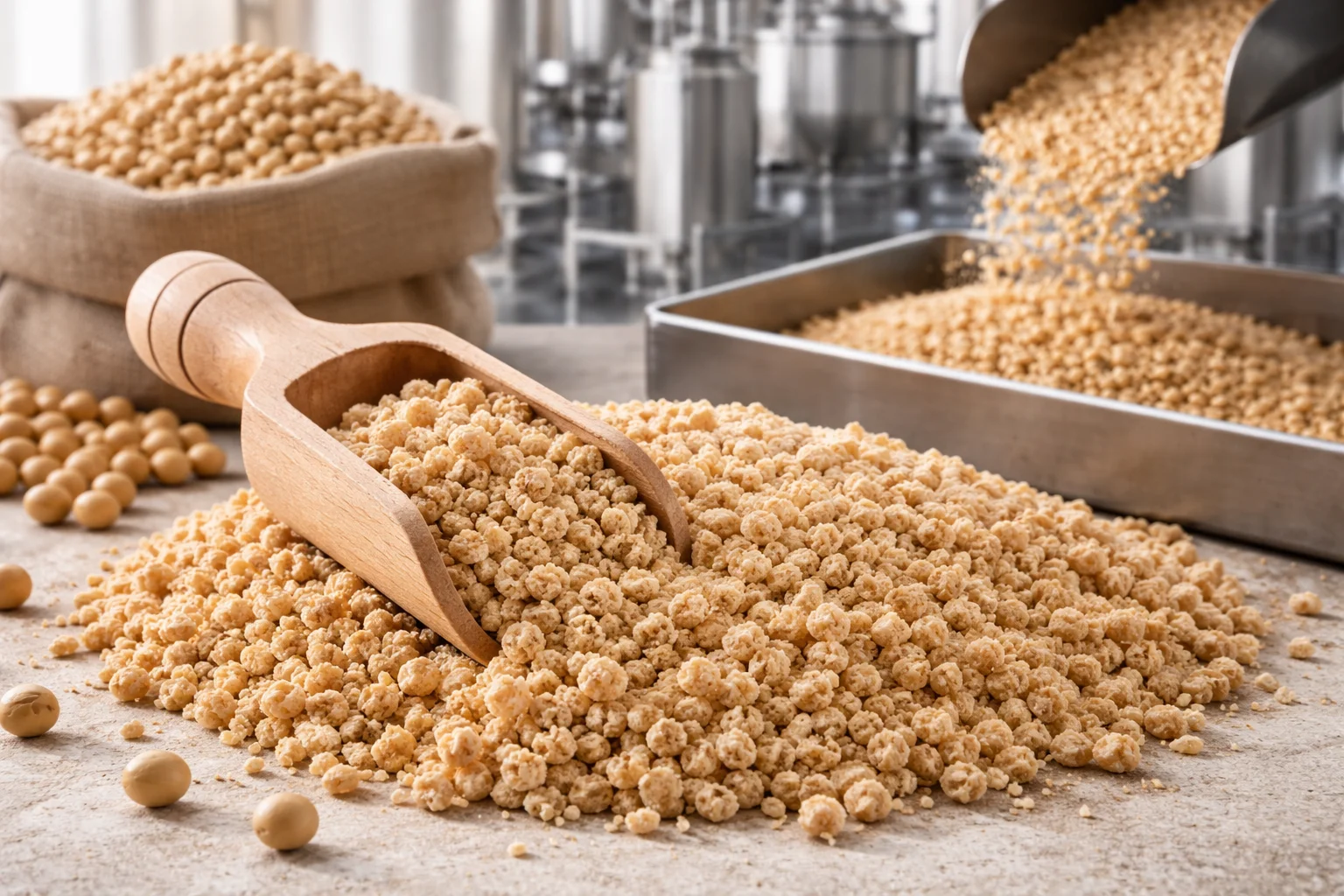
Most people encounter insoya at the final stage of its journey: packed, dried, and ready to cook. What rarely gets attention is how it reaches that form and why it exists in exactly this way. Insoya is not accidental. Its texture, dryness, and neutrality are deliberate outcomes of how it is processed and distributed.
This article looks at insoya from a production and supply-chain perspective. Instead of focusing on cooking or diet trends, it explains where insoya comes from, how it is processed, why it is shaped the way it is, and how those choices influence how people use it at home.
The Starting Point: Soybeans as a Raw Material
Why soybeans are chosen
Soybeans are used to produce insoya because they offer a rare combination of traits:
- High protein concentration
- Stable availability across regions
- Ability to be processed into consistent forms
Unlike many crops that vary widely in quality, soybeans can be standardized more easily. This makes them suitable for large-scale food processing.
See also Weber Grillvorführung 2025: The Hottest Lifestyle Trend for Food-Lovers on the Go
Global cultivation and consistency
Soybeans are grown in multiple regions around the world, which reduces dependency on a single supply source. This contributes to:
- Stable pricing
- Predictable raw material quality
- Year-round production cycles
These factors matter more to processed foods than taste alone.
Why Insoya Is Processed Instead of Sold Fresh
Shelf life as a core requirement
Fresh protein sources spoil quickly. Insoya is designed to avoid that limitation. Drying and texturizing soy protein allows it to:
- Be stored for long periods
- Travel long distances
- Remain usable without refrigeration
This makes it suitable for regions where cold storage is limited.
Predictability over variation
Fresh foods vary from batch to batch. Insoya is engineered to behave the same way every time. This predictability is crucial for:
- Bulk buyers
- Institutions
- Households that want consistent results
Consistency is one of the main reasons insoya exists in its current form.
The Processing Journey: How Insoya Is Created
Protein extraction
The process begins by removing oil from soybeans. What remains is a protein-rich base material. This base is neutral in flavor and stable in composition.
At this stage, the product is not yet recognizably food-like.
Texturization
The extracted protein is then processed under controlled heat and pressure. This step:
- Creates a fibrous structure
- Allows the protein to hold shape
- Enables rehydration later during cooking
This is where insoya gains its defining characteristic: structure without moisture.
Drying and shaping
After texturization, the material is dried completely. Drying:
- Stops microbial growth
- Locks the structure in place
- Enables long-term storage
The product is then cut or granulated into sizes that rehydrate evenly.
Why Insoya Looks the Way It Does
Granules instead of blocks
Insoya is usually granular rather than solid because granules:
- Rehydrate faster
- Absorb seasoning more evenly
- Are easier to portion
This design choice directly affects cooking behavior and acceptance.
Neutral color and flavor
Color and flavor are intentionally minimal. This allows insoya to:
- Blend into different cuisines
- Take on surrounding ingredients
- Avoid overpowering dishes
Strong flavor at this stage would limit versatility.
Packaging and Distribution Logic
Lightweight by design
Dry insoya is lightweight compared to fresh protein. This reduces:
- Transportation cost
- Storage space requirements
- Energy use during distribution
These savings help keep pricing stable across regions.
Shelf storage over cold chains
Insoya does not require refrigerated transport. This simplifies logistics and makes it accessible in areas without advanced infrastructure.
This factor alone explains why insoya appears in markets where other protein sources are difficult to manage.
Why Insoya Is Used in Institutions and Large Kitchens
Standardization matters at scale
In schools, hostels, and community kitchens, variation is a problem. Insoya offers:
- Uniform texture
- Predictable yield after soaking
- Easy scaling of recipes
These traits reduce waste and planning errors.
Training simplicity
Because insoya behaves consistently, new kitchen staff can learn to use it quickly. This matters in environments with frequent staff turnover.
Household Use as a Reflection of Supply Design
Why it fits unpredictable routines
Insoya’s dry form allows households to:
- Cook without advance planning
- Skip frequent shopping
- Handle unexpected guests
These use cases mirror the same predictability needs seen in large kitchens.
Why small amounts go far
Because insoya expands during rehydration, households often underestimate how much they need. This expansion is intentional and tied directly to its processing method.
Market Perception vs Product Reality
Why it is sometimes misunderstood
Insoya is often judged by standards meant for fresh foods. This leads to confusion:
- Expecting natural flavor
- Comparing it to unprocessed protein
- Mislabeling it as filler
These judgments ignore the problem it was designed to solve.
Why acceptance grows with use
Households that use insoya repeatedly tend to accept it because they align expectations with reality. They stop expecting it to perform like fresh meat and start using it where it fits best.
The Role of Insoya in Food Security
Stability during supply disruptions
Because it stores easily and travels well, insoya becomes especially useful when:
- Fresh supplies are interrupted
- Prices fluctuate sharply
- Storage conditions are limited
This role becomes visible during crises, not daily cooking.
Supporting large populations
Insoya’s efficiency makes it suitable for feeding large numbers of people without overwhelming supply systems. This is one reason it remains in production globally.
Why Insoya Has Not Been Replaced
Many alternatives, same challenges
Numerous protein alternatives exist, but many:
- Spoil quickly
- Require refrigeration
- Vary widely in quality
Insoya avoids these issues through processing, which keeps it relevant despite new options.
Infrastructure compatibility
Foods that align with existing storage, transport, and cooking infrastructure survive longer. Insoya fits those systems well.
How Processing Shapes Cooking Behavior
Rehydration is not optional
Because insoya is fully dried, rehydration restores it to a usable state. This step mirrors the reverse of the drying process.
Skipping or rushing it leads to poor results.
Absorption is structural, not chemical
Insoya absorbs liquid into its structure rather than coating the surface. This is why seasoning must be present early in cooking.
Environmental and Resource Considerations
Efficient use of raw materials
Processing soy protein into insoya allows:
- High yield from raw crops
- Minimal spoilage
- Efficient portion control
These factors reduce overall waste.
Transport efficiency
Lower weight and no refrigeration reduce transport impact compared to fresh protein.
Why Household Opinions Differ So Strongly
Exposure without explanation
Many people encounter insoya without understanding its purpose. Without context, it feels disappointing.
Context changes perception
Once people understand why insoya exists and how it is meant to be used, frustration decreases and utility increases.
FAQs
Is insoya artificial?
It is processed, not artificial. Processing shapes structure and shelf life.
Why does insoya need soaking?
Soaking reverses the drying stage and restores usable texture.
Is insoya meant to taste strong?
No. It is designed to carry other flavors.
Why is insoya common in bulk cooking?
Because it is predictable, scalable, and easy to store.
Final Thoughts
Insoya is best understood not as a trend food or a substitute, but as a logistics-driven ingredient. Its form, texture, and neutrality are direct results of how it is processed and distributed to solve real-world food problems.
When judged by those standards—stability, consistency, and adaptability—insoya makes sense. It is not meant to impress on its own. It is meant to work reliably, quietly, and repeatedly wherever dependable food matters most.