








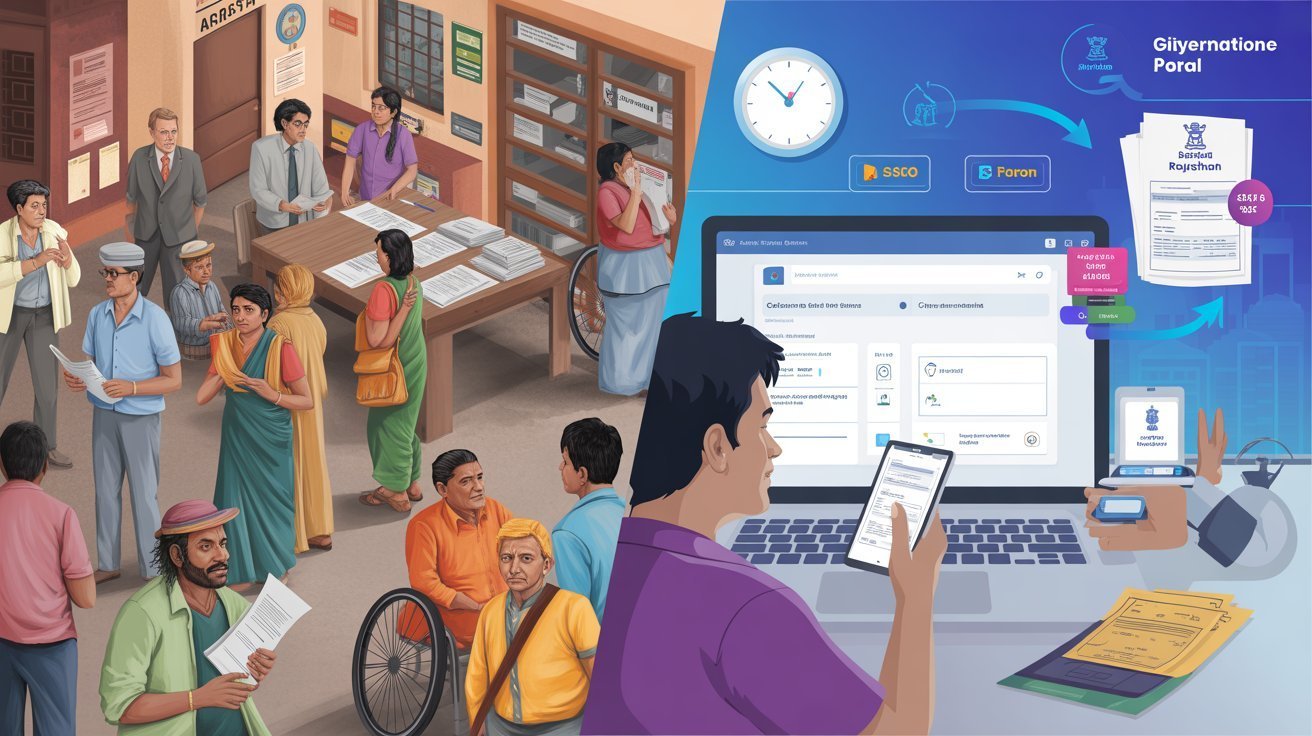
Time is the one resource that every citizen gives up when they need something from the government. And for decades, the cost of that time in Rajasthan was steep. Picture the scene that millions of residents knew well before digital governance arrived: a working day eaten up by a single visit to a tehsil office, a half-formed queue, an absent clerk, and the quiet instruction to come back tomorrow with a photocopy of a document you were not told you needed. That was not the exception; it was the standard experience of accessing public services in a state of over 80 million people.
Understanding how much has changed requires looking honestly at what the old system actually demanded of citizens, and then comparing it to what the Single Sign-On platform now makes possible in its place.
What the Traditional Process Actually Looked Like
The traditional government service model in Rajasthan operated around physical presence. Each department had its own office, its own forms, its own working hours, and its own staff. A citizen who needed a caste certificate, a water bill correction, and a pension status update in the same month was not dealing with one government. They were dealing with three separate bureaucracies, each functioning as an independent island.
The inefficiency was structural, not accidental. Data entered at one office could not be verified or retrieved by another. A document certified at the revenue department was invisible to the social welfare department. Applicants were required to carry physical copies of the same identity proofs to every office they visited, have them attested in person, and sometimes return weeks later to collect results that could have been communicated instantly. The burden of connecting these isolated systems fell entirely on the citizen.
Travel was a hidden tax built into the system. For rural residents, a single government visit could mean half a day of travel to reach a district headquarters, hours of waiting, and the same journey back, all for a transaction that might ultimately take the official less than five minutes to complete. Those who could not afford to take days off work, or who lacked transport, or who had mobility limitations, were systematically disadvantaged. They either paid a middleman to navigate the system on their behalf or went without the service entirely.
Then there was the documentation problem. Each department maintained its own paper-based files. Applications got misplaced. Records were inconsistent between offices. There was no way for a citizen to know whether their application was in a pile on a desk, awaiting a signature, or already processed without physically going back to check. Transparency was not a design principle; it was an afterthought.
The Architecture of the New Approach
The SSOID system did not patch over these problems. It dismantled the architecture that created them and replaced it with something fundamentally different. Instead of departments operating as separate islands, a single authenticated identity now connects a citizen to all of them simultaneously.
When a resident logs in, the system already knows who they are because their identity has been verified once against a government-issued document, typically a Jan Aadhaar or Aadhaar card. That verification travels with them across every service on the platform. There is no re-attestation, no fresh form submission, no re-explaining who you are at each counter. The authenticated session carries your identity forward, and departments receive verified data rather than self-declared claims.
The time comparison becomes stark when you trace a specific task through both systems. Applying for a domicile certificate through the traditional route in Rajasthan historically required a physical application at the tehsil office, manual verification against revenue records, supervisor approval, and physical collection of the document, a process that could take days or weeks depending on workload and staff availability. Through the e-Mitra services accessible via the Rajasthan SSO platform, the same application is submitted digitally, identity is pre-verified through the linked Jan Aadhaar, and the certificate is processed and made available for digital download, often within hours.
Time Savings That Compound Across Every Interaction
The efficiency gain from a single transaction is meaningful. But the real transformation lies in what happens when you multiply that gain across every government interaction a citizen has over their lifetime. A job applicant in Rajasthan who uses the One-Time Registration system fills their personal details once. Every subsequent competitive examination they apply for through RPSC or RSMSSB draws on that single registration automatically, pre-populating forms without requiring the applicant to re-enter the same biographical and educational information they have already submitted and verified. The accumulated time saved across multiple applications is substantial.
The same logic applies to a business owner managing GST filings, trade license renewals, and industrial clearances through the Udyog category of the platform. What previously required separate visits to the commercial tax office, the municipal corporation, and the industries department can now be managed from a single dashboard session. The authentication is the same. The forms draw on the same registered business details. The status tracking is real-time and visible without a follow-up visit.
For government employees managing salary records, leave applications, and provident fund details through PayManager and other integrated services, the reduction in administrative overhead is equally significant. Tasks that once required paper-based requests routed through departmental channels are now handled digitally with the same SSOID that serves as the entry point to everything else.
Transparency as a Time-Saving Feature
One underappreciated aspect of the digital system is that transparency itself saves time. In the traditional model, citizens had no reliable way to check the status of an application without physically visiting the relevant office. That uncertainty created its own overhead, additional trips, follow-up phone calls, and the anxiety of not knowing whether a critical document would arrive before a deadline.
The SSO-integrated portal sends notifications and allows real-time status checks from any device. When a scholarship application is processed, the applicant knows immediately. When a certificate is ready for download, the system generates an alert. The mental cost of managing government interactions, the task of remembering what you submitted, where, and when, drops considerably when all activity lives within one tracked dashboard.
The Honest Accounting of What Has Changed
The comparison between the traditional process and the digital one is not a case of minor improvement. It is a structural replacement of a system that was expensive in time, opaque in process, and exclusionary for anyone who lacked the physical ability, geographic proximity, or social connections to navigate it.
Every service that now takes minutes at a phone screen once took hours at an office window. Every document that now downloads instantly once required a queue and a physical counter. And every citizen who can complete a government interaction without taking a day off work is experiencing, in the most practical terms, the difference that digital governance makes when it works as designed.